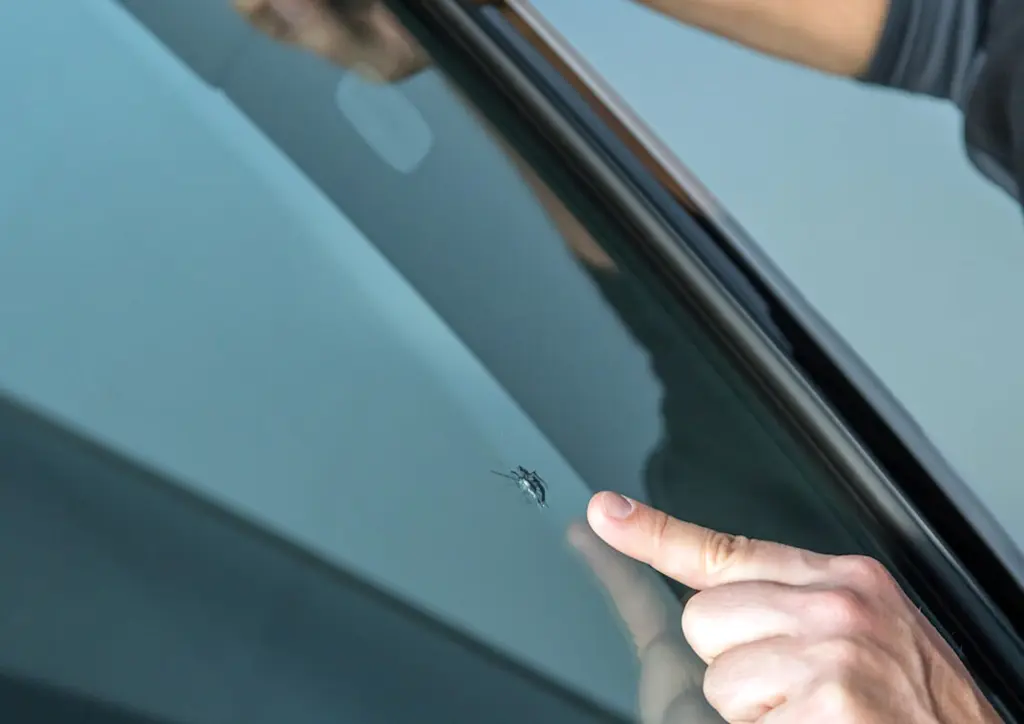
The Physics of Thermal Shock: Why Your Windscreen Chip Thinks It’s a Drama Queen
Every driver knows the absolute heartbreak of that sudden TICK sound on the motorway. A rogue pebble, fired at supersonic speeds by the lorry in front, has officially moved onto your glass. It leaves behind a tiny, innocent-looking speck.
You look at it, it looks at you, and you mutually agree to ignore each other for the next three months.
You think you are safe. But that tiny chip is secretly a ticking time bomb waiting for the perfect weather shift to stage a massive, dramatic explosion across your line of sight.
The culprit behind this structural mutiny? A little thing called thermal shock.
The Anatomy of a Glass Sandwich
To understand why chips are so emotionally unstable, you have to look at how modern windscreens are built. Your car’s windscreen is not just a standard window pane; it is a highly engineered structural safety component made of laminated glass. This means it is a glass sandwich: two layers of tough glass held together by a clear plastic middle layer.
When a stone strikes, it usually only fractures the very outer layer. The plastic middle layer stops the whole thing from instantly collapsing into your lap. However, that fresh nick means the uniform tension of the glass is completely compromised. It is now under immense pressure, just waiting for an excuse to snap.
When a stone strikes, it usually only fractures the very outer layer. The plastic middle layer stops the whole thing from instantly collapsing into your lap.
What Exactly is Thermal Shock?
Glass expands when it gets hot and contracts when it gets cold. When a windscreen is perfectly healthy, this happens smoothly across the entire surface. No drama.
Thermal shock happens when different parts of the exact same piece of glass experience massive temperature changes at the same time.
When one area expands faster than the freezing glass right next to it, it creates intense mechanical stress. Because your stone chip behaves exactly like a perforation on a toilet roll, all that stress focuses entirely on that one tiny weak point causing thermal shock.
The Two Ways Drivers Accidentally Trigger an Explosion
Thermal shock usually catches motorists by surprise during seasonal weather extremes:
-
- The Winter Meltdown: It’s a freezing morning. Your car is coated in ice. You decide to blast the climate control on full heat (or worse, pour hot water on it). The interior glass expands violently while the outer edges are still frozen solid. SNAP. Your tiny chip instantly transforms into a giant crack resembling the Grand Canyon.
- The Summer Ice-Box: Your car has been roasting in the summer sun all day, and the glass is sitting at a casual 45°C. You jump in, crank the air conditioning to maximum arctic freeze, and aim the vents right at the glass. The sudden localised contraction forces the fracture open.
Don’t Wait for the Drama – Let Us Fix It
Once a chip decides to make its big move and turns into a crack, the structural integrity is completely gone. At that point, a quick repair is off the table, and you are stuck paying for a full, expensive windscreen replacement.
Fixing a chip before thermal shock takes over takes less than 20 minutes. Our expert independent mobile technicians will travel directly to your home or workplace across Suffolk, Cambridgeshire, Norfolk, Lincolnshire, Bedfordshire, Northamptonshire, Hertfordshire, Essex, and Oxfordshire to inject a specialist resin that restores the strength of your glass.
Beat the weather to the punch. Get that tiny chip sorted before a sudden change in temperature forces you into a much bigger garage bill.
Thermal Shock is a real threat to your windscreen’s integrity.
Need a Quick Fix?
Don’t wait until you have to replace the whole thing. Contact the Screen Chips team today:
- Book an Appointment Online
- Call Us Now: 0330 043 5502
- Email: sales@screenchips.co.uk